The Minimum Amount Due Trap on Your Credit Card Bill
Every credit card statement shows two important numbers: the Total Amount Due and the Minimum Amount Due. The minimum looks small and comfortable - but paying only that amount is one of the most expensive habits a cardholder can have.
What is the minimum amount due?
The minimum amount due is the smallest payment you must make by the due date to avoid a late payment fee and to keep your account in good standing. It is usually a small percentage of your outstanding balance, plus any EMIs, fees and charges for that month. The exact formula is set by your bank.
What happens if you pay only the minimum?
Paying the minimum avoids the late fee, but it does not avoid interest. Here is what usually happens:
- Interest is charged on the unpaid balance - and often from the date of each purchase, not just from the due date.
- You lose the interest-free period on new purchases. While a balance is carried forward, new spends may also start attracting interest straight away.
- Interest rates on cards are high. On many cards they are around 3% to 4% per month, which adds up to a very high yearly rate. Check your own card's rate in its terms.
- Your debt can stay for months or years, because most of your small payment goes towards interest and charges, not the actual amount you spent.
A simple example
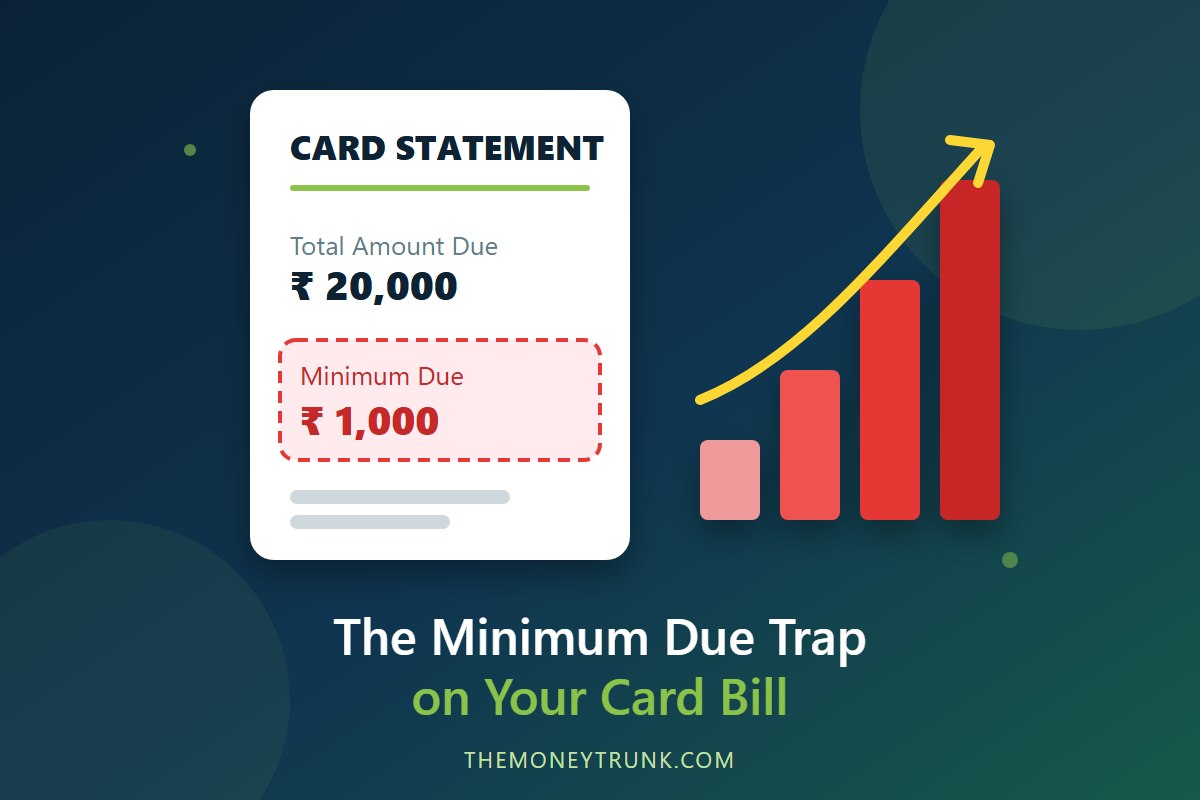
Say your bill is Rs. 20,000 and the minimum due is about Rs. 1,000. If you pay only Rs. 1,000, the remaining Rs. 19,000 is carried forward. Interest is added on this balance (and possibly on your new purchases too). Next month, your bill is higher than Rs. 19,000 even if you do not spend anything new - and if you keep paying only the minimum, it can take a very long time to clear the original Rs. 20,000, with you paying much more than you borrowed.
(Figures are for illustration only. Actual interest depends on your card's rate and how your bank calculates it.)
It can also hurt your credit score
Paying the minimum on time is not marked as a missed payment. But carrying a high balance month after month means you use a large part of your credit limit, which can pull your score down and make lenders see you as a higher risk.
How to get out of the minimum-due trap
- Always try to pay the total amount due.
- If you cannot pay in full, pay as much as you can - more than the minimum - to reduce the interest.
- For a big purchase, ask your bank about converting it to EMI, which usually costs less than revolving interest (check the rate and processing fee first).
- If you have balances on several cards, consider a lower-interest personal loan to clear them, and then stop using the cards until you are back on track.
- Set up auto-pay for the total amount due so you never fall into the habit.
Bottom line
The minimum due is a safety net for a tight month, not a payment plan. Paying the full bill every month keeps your card free to use and your credit score healthy.
Note: Interest rates, minimum due formulas and charges are set by each bank and can change. This article is for general information only.
 Home
 EMI
 Cards
 Loan
 Insurance
 Support